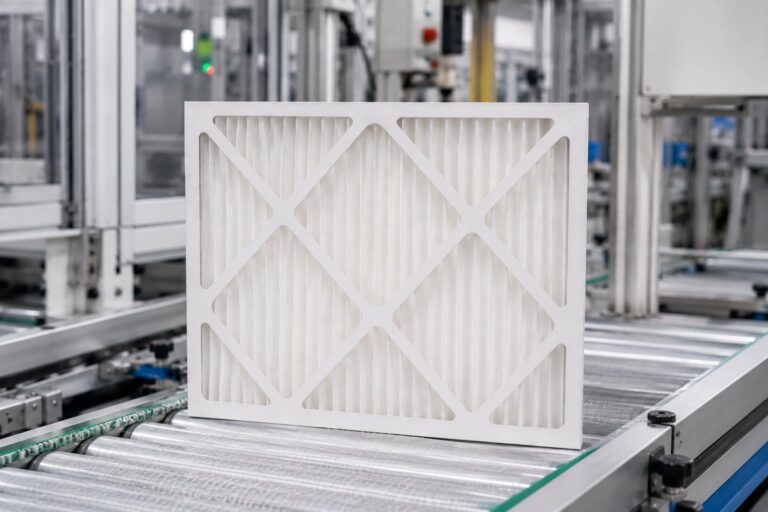
Decision summary
Use the comparison only when the underlying conditions match.
This guide is limited to ventilation and HVAC filtration. It does not cover compressed air, liquid filtration or process dust collection. Begin with contaminants, airflow, housing and pressure budget.
Source rule: Final publication must link the applicable standard or authoritative primary source. This implementation does not insert unverified citations or reproduce standard text.
Comparison method
Keep the decision variables visible.
Technical comparisons become misleading when a class label is separated from the standard, airflow, particle range, product construction or test method.
| Decision field | Record | Common error to avoid |
|---|---|---|
| Objective | Particle, odour, equipment or process requirement | Choosing from a label without the use case |
| Standard | Full standard and class or grade | Converting classes with a generic percentage |
| Air condition | Airflow or face velocity and temperature | Comparing resistance at different conditions |
| Construction | Media pack, frame, seal and depth | Transferring data between product families |
| System limit | Available space and pressure budget | Selecting efficiency without system fit |
| Evidence | Source version and product or model | Using an undated or unattributed table |
Turn the research into an RFQ.
Record the option you are considering, then add the dimensions, airflow, resistance limit, materials, operating conditions and quantity. Unknown fields can be marked for review.
- Link the requirement to one product family
- Attach the standard or customer specification
- Keep every number next to its condition
- Request a model specific datasheet before approval